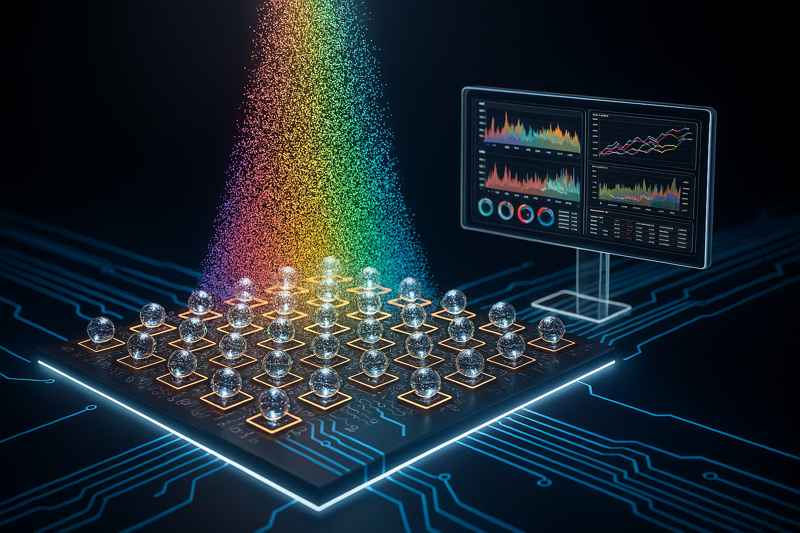
Quantum dots (QDs) are tiny particles made of semiconductor materials, suspended in a solution. Their surface is coated with molecules that keep them stable and prevent clumping, while also influencing their electrical behavior.
What’s amazing is that we can tune their properties by changing the composition, shape, and size of the particles. This lets us control which wavelengths of light they absorb and, in turn, the performance of the devices that use them.
Colloidal quantum dot technology first made its commercial debut in the late 1990’s as visible light-emitting bio taggants. Then in 2009 and 2013 also leveraging their ability to emit tunable and narrow-band red and green light when excited with blue light, they arrived commercially in the form of color conversion materials in solid state lighting products and LCD TVs and tablets.
It was not until 2018 that QDs were leveraged commercially for their ability to absorb a broad spectrum of wavelengths of light and convert that light into electrical charge. It took roughly 20 years of technology development to commercialize colloidal QD-based photodetectors and image sensors.
PbS QD image sensors are the first commercial products in the marketplace to use colloidal QDs in electro-active devices in contrast to all of the other current products that use colloidal QDs in photoluminescence mode.
Colloidal QD optoelectronic devices require the QDs to remain stable in the presence of active charge and electric fields, which trigger a whole set of new degradation mechanisms not present in photoluminescent-based colloidal QD components.
It is very exciting that we are now entering into a new era of colloidal QD optoelectronic device products starting with photodetectors and image sensors and very likely soon QD-LEDs, solar cells, and eventually lasers.