
10/12/2025
Quantum dots (QDs) are tiny particles made of semiconductor materials, suspended in a solution. Their surface is coated with molecules that keep them stable and prevent clumping, while also influencing their electrical behavior.
What’s amazing is that we can tune their properties by changing the composition, shape, and size of the particles. This lets us control which wavelengths of light they absorb and, in turn, the performance of the devices that use them.
Another big advantage? They’re easy to process! Since they’re dispersed in solution, they can be deposited using simple techniques like spin-coating or drop-casting, making production more affordable and accessible.
QDs particles have some characteristics that made them extremely important:
- Size – tunable light sensitivity: this is the key advantage. It is enough to change the size of the quantum dot to modulate the response. With traditional tools (e.g., Fabry–Perot filter), each filter is fixed at a specific wavelength, and to cover the NIR and SWIR ranges you need a mosaic of filters, where the cavity geometry determines the wavelength. Instead, with quantum dots, the cavity can remain the same, and by changing the QD size you can shift the spectral response. This enables the design of multispectral arrays without modifying the optical structure.
- High quantum energy: Quantum dots exhibit high quantum efficiency, meaning that a large fraction of absorbed photons is converted into emitted photons (or charge carriers), minimizing non-radiative losses, and enabling superior performance.
- Easily processable: since they are dispersed in solution, we can manipulate and deposit them using simple techniques.
What are the benefits of Quantum Dots?
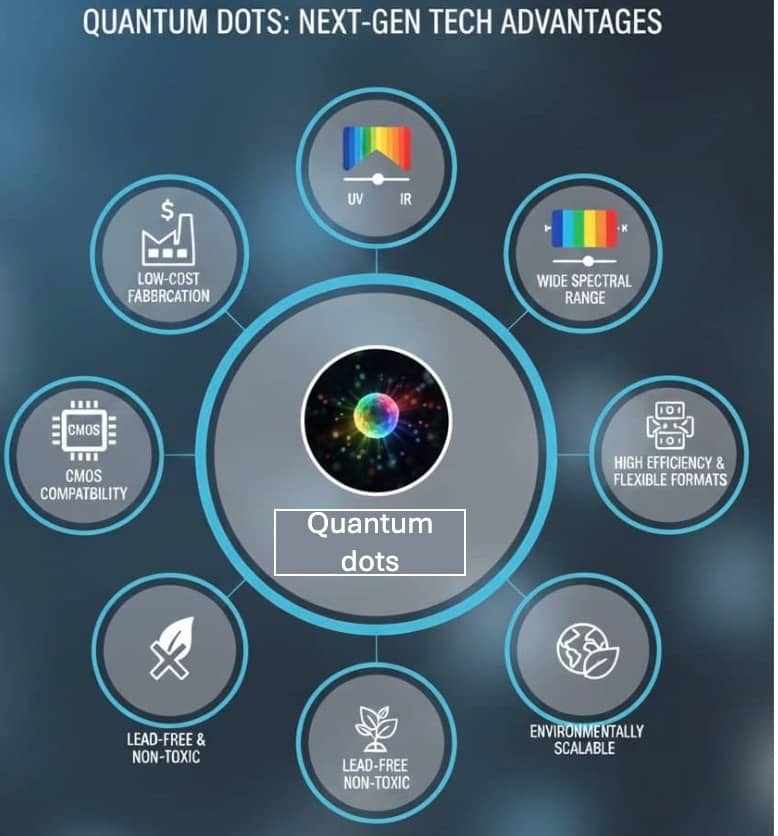
- Low-cost fabrication: The use of QDs enables the development of instruments with simpler configurations and easier processing techniques, leading to cost reduction and high scalability.
- Wide spectral range: By tuning the elements, the shape of the QDs, and the size of the nanocrystals (which can range from 2 to 10 nanometers), it is possible to cover virtually the entire spectrum (from UV to IR).
- CMOS (Complementary Metal-Oxide-Semiconductor) compatibility: Compatibility with flexible CMOS substrates allows the integration of QD photodiodes directly on-chip, enabling cost-effective and miniaturized devices.
- High efficiency in small and flexible formats: Thanks to the Compatibility with flexible CMOS substrates, it is possible to develop miniaturized and compact devices while maintaining high efficiency.
- Environmentally scalable: Emerging lead-free QD technologies address one of the major limitations of this approach: the toxicity of the elements used. Increasingly, greener alternatives are being discovered to replace lead, making the technology more sustainable.
Colloidal QD materials can function in several ways: photoluminescent, photoabsorptive, photoelectric, and electroluminescent. Consequently, numerous devices can be developed by exploiting QD nanoparticles: photoconductive devices, photodiodes, phototransistors, and other light-sensing technologies.
To simplify the concept, we can imagine QDs as tiny antennas that capture light and transform it into an electrical signal which we can then analyze to extract information.
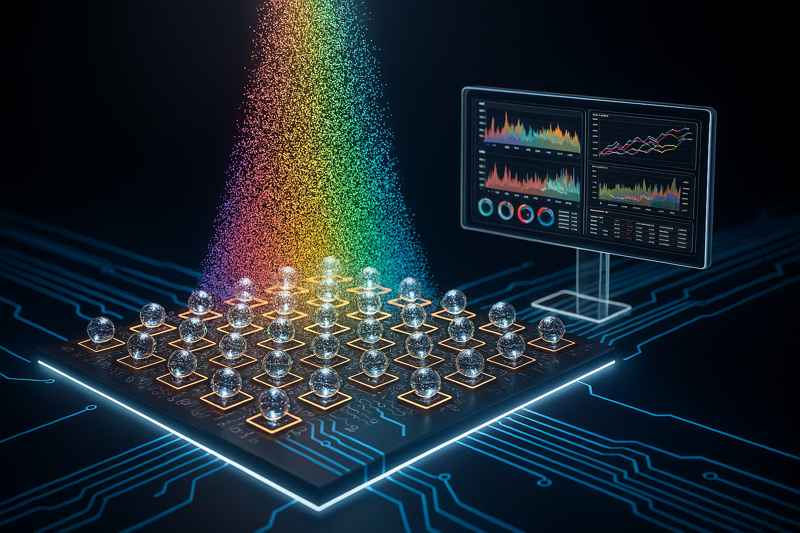
Quantum Dots: The New Frontier of Light Sensitivity
Colloidal quantum dots already have commercial importance in applications where they need to emit light, but recently they have also proven promising in the field of light sensing.
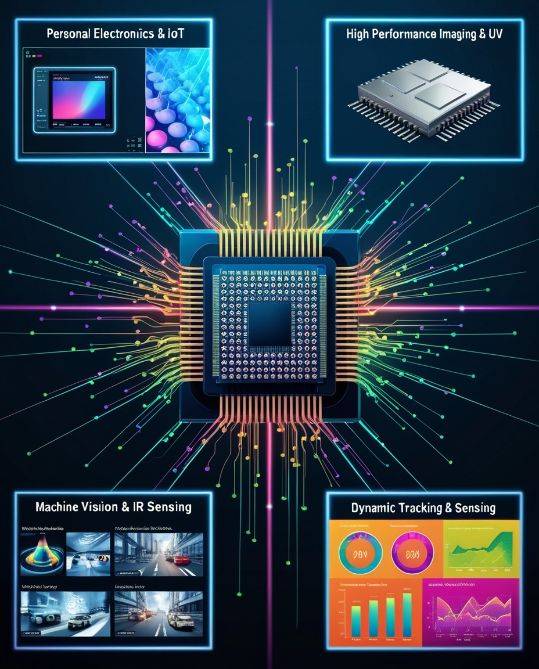
The application sectors are numerous: ranging from photography to machine vision, through medicine and personal electronics, covering practically all bands of the electromagnetic spectrum, from infrared to UV.
The versatility of QD-based technologies enables the commercial development of light-sensing technologies at significantly lower costs compared to traditional ones, especially for the SWIR (Short-wave infrared) band.




Leave A Comment